
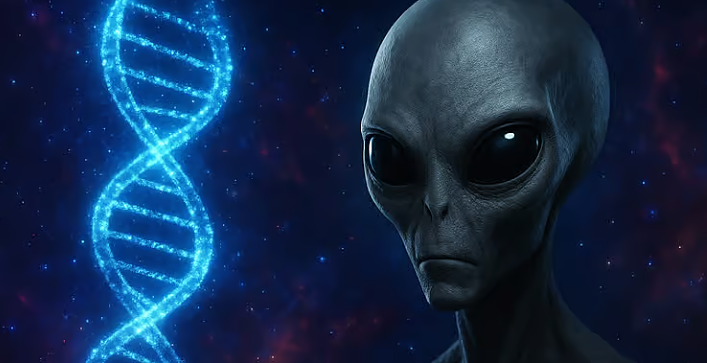
We’ve long asked: Are we alone in the universe?
But a harder question remains: If we find life, how will we know it’s truly alive — and not just Earth contamination?
Forensic genetics, usually used for crime scenes, could help. On Earth, life is DNA- or RNA-based, but alien life might use completely different molecules. To identify it, scientists may look for:
Organized molecular patterns – signs of replication or information storage
Chirality of amino acids – a hallmark of life
Lipid or membrane structures – indicators of cellular organization
Isotopic signatures – ratios that distinguish biological from non-biological chemistry
Replication errors – patterns showing heredity or evolution
Even without DNA, these features could signal life.
Missions to Mars, Europa, or Enceladus risk bringing Earth DNA, creating false positives. Planetary protection rules exist, but forensic genetics could trace contamination, authenticate samples, and maintain a biological chain of custody in space.
A new field is emerging: where astrobiology meets forensics, helping humanity answer the ultimate question:
“Is this truly not from Earth?”
 How Bioinformatics Powers Prec...
 Astrobiology and Biosafety: Se...
 Scientific Foundations and App...
 The Personal and Legal Importa...
Copyright @ GeneSafety. Created By WebCenter